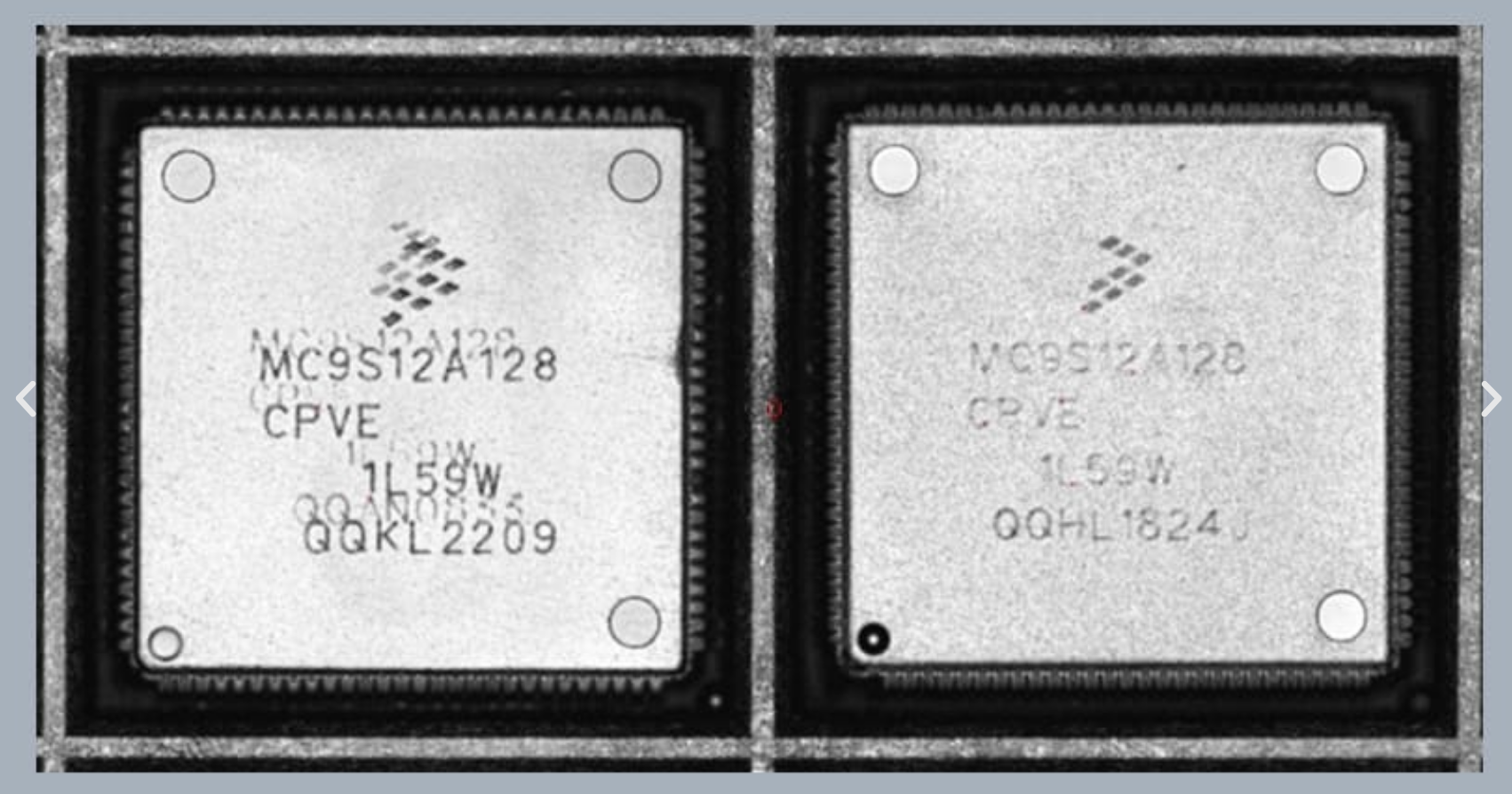
Scanning acoustic microscopy (SAM) or Acoustic Micro Imaging (AMI) is a powerful, non-destructive technique that can detect hidden defects or counterfeits in elastic and biological samples as well as non-transparent hard materials.By monitoring the internal features of a sample in three-dimensional integration, this technique can efficiently find physical defects such as cracks, voids, and delamination with high sensitivity.
Beyond visual inspection, our laboratory performs comprehensive electrical and material characterization to validate component functionality and detect hidden counterfeit indicators. Testing capabilities include.

Our counterfeit detection process follows internationally recognized standards, including AS6171, IDEA-STD-1010, SAE AS5553, and ISO 9001 quality practices. Every component undergoes a risk-based inspection process designed to identify evidence of remarking, resurfacing, unauthorized refurbishment, cloning, and material substitution.
Counterfeit electronic components can lead to product failures, safety risks, and costly recalls. At Altest Corporation, our Counterfeit Component Testing services combine visual inspection, X-ray analysis, decapsulation, electrical testing, XRF material verification, and traceability validation to identify counterfeit, remarked, refurbished, and cloned components before they enter production. Following industry standards such as AS6171, SAE AS5553, and IDEA-STD-1010, we help OEMs and EMS manufacturers ensure component authenticity, improve supply chain integrity, and deliver high-reliability electronic products for aerospace, defense, medical, automotive, and industrial applications.
.jpg)

With decades of expertise in electronics manufacturing, quality engineering, and component verification, Altest Corporation provides reliable counterfeit detection services for industries where product failure is unacceptable. Our experienced engineers utilize advanced inspection technologies and internationally recognized authentication standards to identify counterfeit components before they impact manufacturing or field performance. Whether validating high-value semiconductors, military-grade electronics, medical devices, or industrial control systems, we deliver comprehensive testing solutions that safeguard product quality, improve supply chain integrity, and reduce operational risk.
Find answers to common questions about component authenticity, decapsulation, XRF analysis, detecting blacktopped chips, and AS6081 supply chain mitigation.
Counterfeit component testing is a rigorous sequence of visual, physical, chemical, and electrical inspections designed to verify the authenticity of electronic parts. The goal is to ensure that the components being placed on your PCB are genuine, brand-new parts from the original manufacturer, not fake or salvaged replicas.
Due to global supply chain shortages and component obsolescence, many buyers are forced to source parts from independent brokers rather than franchised distributors. This creates an opening for counterfeiters to infiltrate the market with fake chips, which can cause catastrophic, unpredictable system failures in the field.
Blacktopping is one of the most common counterfeiting techniques. Scammers take a cheap or salvaged IC, sand off the original part number, and coat the top with a thin layer of black polymer resin (the "blacktop"). They then laser-etch a new, more expensive part number onto the fake surface to deceive buyers.
We start with high-magnification optical microscopy to look for sanding marks, inconsistent textures, or incorrect logo typography. We also use specialized chemical solvents (like acetone or heated 1-Methyl-2-pyrrolidone) in a swipe test. These solvents will dissolve fake blacktop resin and wipe away fake ink, but will not harm genuine manufacturer epoxy.
Some counterfeits use empty plastic packages containing no actual silicon die ("dummy chips"). Real-time 2D/3D X-Ray allows us to look inside the component without destroying it. We compare the internal die size, lead frame geometry, and delicate wire-bonding patterns against a known authentic "golden" component or the manufacturer's datasheet.
Decapsulation is a destructive test. We use highly controlled, heated corrosive acids (like fuming nitric or sulfuric acid) to safely etch away the top plastic packaging of an IC. This exposes the bare silicon die inside. We then use a metallurgical microscope to verify the original manufacturer's microscopic logo and part numbers etched directly into the silicon.
XRF is a non-destructive analytical technique used to determine the exact elemental composition of materials. In counterfeit testing, we use it to analyze the metallic plating on the component leads. This verifies if the part is truly RoHS-compliant (lead-free) or if a counterfeiter has illegally re-tinned salvaged leaded components to sell them as new.
We utilize Electrical Curve Tracer testing. This maps the unique electrical characteristics (Current-Voltage or I-V curve) of the component's pins without fully powering it up. If a chip is a completely different internal part rebranded to look like another, its electrical signature will instantly fail against the known authentic curve.
No, testing every resistor and capacitor would be prohibitively expensive. We target "high-risk" parts. This includes expensive FPGAs, microcontrollers, obsolete/EOL (End of Life) components, and any parts that were explicitly sourced from independent, non-franchised brokers to fulfill supply chain gaps.
Our laboratory and incoming inspection protocols strictly adhere to the AS6081 (Fraudulent/Counterfeit Electronic Parts: Avoidance, Detection, Mitigation, and Disposition) standard, as well as IDEA-STD-1010. These stringent aerospace and defense standards guarantee the absolute integrity of your supply chain.
Partner with Altest Corporation for your next high-reliability PCB fabrication and turnkey SMT assembly project. Our engineering team is ready to review your gerber files and provide a detailed, competitive estimate.