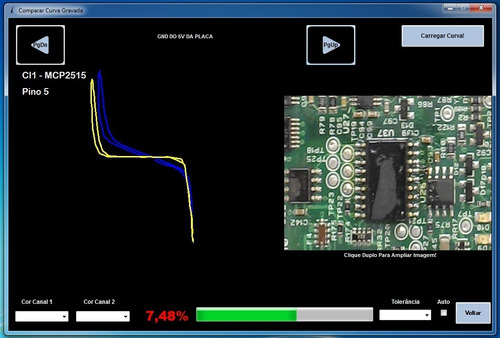
At Altest Corporation, our Curve Tracer Testing services provide fast, non-destructive electrical characterization of semiconductor devices and PCB assemblies by analyzing their Current-Voltage (I-V) signatures. This advanced diagnostic technique verifies the electrical behavior of components without powering the complete circuit, enabling engineers to quickly identify defective, counterfeit, overstressed, or degraded devices. Curve Tracer Testing is widely used for incoming component inspection, PCB failure analysis, engineering validation, quality assurance, repair verification, and root cause investigation, ensuring the highest level of reliability for mission-critical electronic products.
Our Curve Tracer Testing capabilities support a broad range of electronic components and PCB technologies.
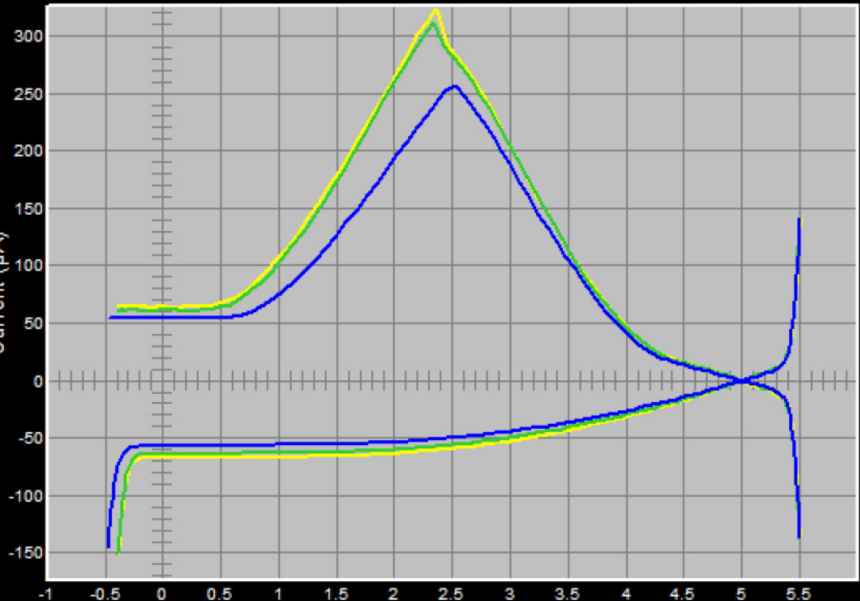
Every semiconductor device has a unique electrical signature that reflects its operating characteristics. Our advanced curve tracing systems compare measured I-V curves against known-good reference devices or manufacturer specifications to detect abnormalities such as open circuits, short circuits, leakage currents, junction breakdown, incorrect component values, polarity errors, damaged PN junctions, and Electrical Overstress (EOS) or Electrostatic Discharge (ESD) failures. This allows rapid fault isolation without unnecessary component removal, reducing troubleshooting time and improving diagnostic accuracy.
With decades of expertise in PCB testing, electronics manufacturing, and semiconductor failure analysis, Altest Corporation delivers precise electrical signature analysis backed by advanced diagnostic equipment and experienced reliability engineers. Our IPC-compliant testing procedures help OEMs identify hidden electrical defects, authenticate semiconductor devices, improve manufacturing quality, and reduce field failures. Whether you're validating a prototype, investigating a production issue, or verifying component authenticity, our Curve Tracer Testing services provide the engineering confidence needed for today's most demanding electronic applications.
Find answers to common questions about I-V signature analysis, unpowered board diagnostics, counterfeit part detection, and electrical overstress screening.
Curve tracer testing is an electrical diagnostic method that applies a current-limited AC signal across the pins of a component to measure the relationship between Current (I) and Voltage (V). This creates a unique visual graph or "signature" of the semiconductor's internal P-N junctions, resistors, and capacitors.
Counterfeiters often remark cheap, completely different chips to look like high-value parts. Even if the outside looks identical, the internal silicon die will have a completely different electrical layout. Curve tracing instantly reveals this fraud because the suspect chip's I-V signature will fail to match the electrical signature of a known authentic component.
No, it is a strictly non-destructive test. Curve tracers are engineered to apply very low, highly controlled currents and voltages. This allows us to safely stimulate the internal junctions to gather data without causing any electrical overstress (EOS) or damage to the delicate silicon die.
A "Golden" unit is a known-good, 100% authentic, and fully functional reference part or assembled board. Before testing a suspect batch or repairing a broken board, our automated curve tracer "learns" and stores the perfect I-V signatures from the Golden unit to use as a baseline for comparison.
Yes. This technique, often called "Analog Signature Analysis" (ASA), is incredibly valuable for board-level diagnostics. We can probe specific nodes on a fully populated, failing PCBA and compare those signatures to a working board to rapidly pinpoint short circuits, open traces, or degraded components without powering up the faulty board.
No, curve tracing is a "power-off" testing method. The PCBA is not connected to its main power supply. The only electricity introduced into the circuit is the safe, localized stimulus provided directly by the curve tracer probes. This makes it the safest way to troubleshoot a dead or severely shorted board that might catch fire if fully powered.
Curve tracing is highly effective at identifying Electrostatic Discharge (ESD) damage, Electrical Overstress (EOS), severed internal wire bonds, degraded P-N junctions, missing electrostatic protection diodes, and catastrophic short/open circuits within a component's packaging.
Functional Testing (FCT) applies full system power to verify if the board's logic, software, and outputs operate correctly. Curve tracing does not check logical operation; it evaluates the fundamental physical and electrical integrity of the hardware. They are complementary—curve tracing verifies the hardware is safe and authentic before FCT verifies the logic.
No, a schematic is not strictly necessary. Because curve tracing is comparative (suspect vs. golden), we can troubleshoot and reverse-engineer legacy or undocumented PCBAs entirely by mapping the electrical signatures of a known working unit and hunting for deviations on the broken unit.
Yes. Curve tracer electrical testing is a key requirement in rigorous aerospace and defense counterfeit mitigation protocols, including SAE AS6081 and AS6171. It provides objective, documented proof that components sourced from independent brokers are electrically consistent with the original manufacturer's specifications.
Partner with Altest Corporation for your next high-reliability PCB fabrication and turnkey SMT assembly project. Our engineering team is ready to review your gerber files and provide a detailed, competitive estimate.